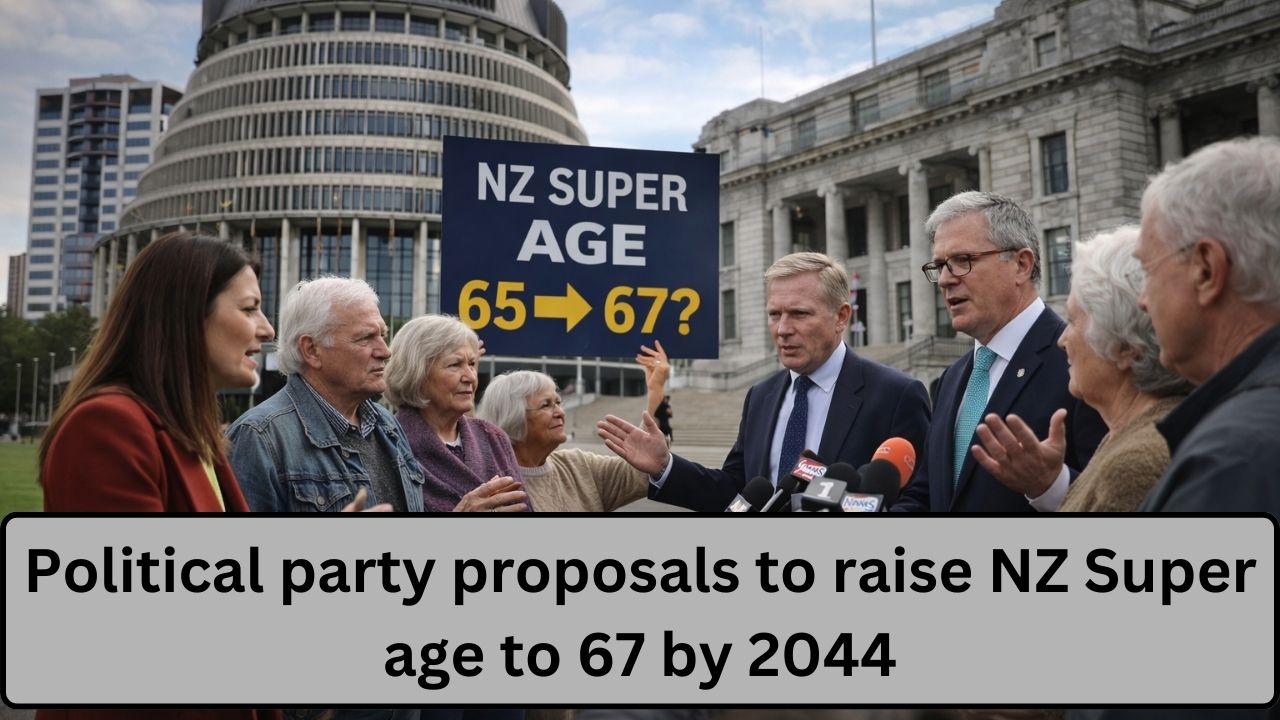
As New Zealand’s population ages and public spending pressures grow, one idea keeps resurfacing in political debate: raising the NZ Superannuation eligibility age from 65 to 67 by 2044. While no change has been made, and none is imminent, several political parties have openly floated proposals or signalled support for a gradual increase over the next two decades.
The discussion has sparked strong reactions — especially among older workers and those nearing retirement — making it one of the most sensitive long-term policy issues in the country.
Here’s a clear explanation of who is proposing what, why the idea exists, and what it would actually mean.

The Current Rule: NZ Super Starts at 65
At present, New Zealand Superannuation:
- Is paid from age 65
- Is universal (not income- or asset-tested)
- Is indexed to wages
- Forms the main retirement income for most New Zealanders
There is no legislated increase to the age. Claims that it has already changed are false.
Why the Age-67 Proposal Exists
Supporters of a gradual increase argue that demographic realities are changing.

Key pressures include:
- People living longer, on average
- A growing ratio of retirees to workers
- Rising long-term pension costs
- Fiscal pressure on future governments
Policy analysts estimate that without changes, NZ Super will consume a much larger share of government spending over coming decades.
Which Political Parties Have Proposed or Supported an Increase
ACT Party
The ACT Party has been the most explicit supporter of raising the NZ Super age.

Their position includes:
- Gradually increasing the eligibility age to 67
- Phasing the change in over many years
- Starting well into the future, often cited as reaching 67 by around 2044
ACT argues this aligns NZ with international trends and reflects longer life expectancy.
National Party (Historical Signals, Not Current Policy)
The National Party has previously supported increasing the age — notably campaigning on it in the past — but has since stepped back from an active proposal.

Current stance:
- No immediate plan to raise the age
- Acknowledges long-term sustainability issues
- Emphasises certainty for current and near-retirees
National has not committed to a 2044 target, but the idea remains part of broader policy discussion.
Labour Party
The Labour Party has consistently opposed raising the NZ Super age.

Their position:
- Maintain eligibility at 65
- Focus on funding NZ Super through general taxation
- Emphasise fairness for workers in physically demanding jobs
Labour argues that age increases disproportionately harm people who cannot easily work longer.
Green Party
The Greens strongly oppose raising the age.

Their view:
- NZ Super should remain at 65
- Inequality in life expectancy makes age rises unfair
- Focus should be on wealth, not age
They argue that those in lower-income or manual roles would bear the brunt of any increase.
Why 2044 Keeps Being Mentioned
The year 2044 appears frequently because:

- It allows a very slow phase-in
- It avoids impacting anyone currently near retirement
- It spreads political risk across future governments
Under typical models, the age would rise by a few months every year or two, starting well into the 2030s.
Who Would Be Affected — and Who Wouldn’t
If an age increase were ever adopted:
Not affected:
- Current NZ Super recipients
- People aged 50s and early 60s today
- Anyone already planning retirement under current rules
Potentially affected:
- Younger workers currently under 40
- Future generations with longer life expectancy
This is why proponents frame it as a future-facing policy, not a current cut.

Why the Proposal Is So Controversial
Opponents point out several risks:
- Many older workers struggle to stay employed
- Health outcomes vary sharply by income and occupation
- Life expectancy gains are uneven
- Raising the age saves money but shifts hardship
Supporters counter that:
- Keeping the age unchanged shifts costs to younger generations
- Longer lives justify longer working lives
- Gradual change gives time to adapt
The debate is fundamentally about fairness across generations.
What Has Not Changed
Despite online rumours:
- NZ Super age is still 65
- No legislation exists to raise it
- No timeline has been adopted
- No cross-party agreement is in place
Any change would require:
- New legislation
- Long lead times
- Extensive public debate
Sudden changes are extremely unlikely.
Government Position Right Now
The New Zealand Government has not committed to raising the age.
Official signals emphasise:
- Stability for current retirees
- Gradual planning rather than sudden reform
- KiwiSaver improvements as the first lever
Raising the age remains a policy proposal, not a decision.
Public Reaction
Public opinion remains deeply divided.
- Younger voters are more open to future increases
- Older voters strongly oppose any change
- Manual workers express particular concern
- Trust hinges on long notice and fairness
Politically, NZ Super remains one of the most sensitive policies in the country.
Common Questions People Are Asking
1. Is NZ Super age rising to 67 now?
No.
2. Has 2044 been locked in?
No — it’s a proposed timeframe, not law.
3. Which party supports the increase most clearly?
ACT.
4. Would current retirees be affected?
No.
5. Would people in their 50s be affected?
Very unlikely.
6. Why not means-test instead?
That debate exists, but no change has been adopted.
7. Is this happening overseas?
Yes, many countries have higher pension ages.
8. Is life expectancy the same for everyone?
No — that’s a key criticism of age rises.
9. Could the policy be dropped entirely?
Yes — nothing is decided.
10. When would this realistically be decided?
Only in a future election cycle.
Bottom Line
Proposals to raise the NZ Super age to 67 by 2044 are part of long-term political debate — not current law. While some parties argue it’s necessary for sustainability, others see it as unfair and unnecessary.
For now, NZ Super remains payable from age 65, and any future change would be slow, heavily signalled, and fiercely contested. As with many retirement issues in New Zealand, the biggest risk today isn’t policy change — it’s misinformation about changes that haven’t happened.









Leave a Comment