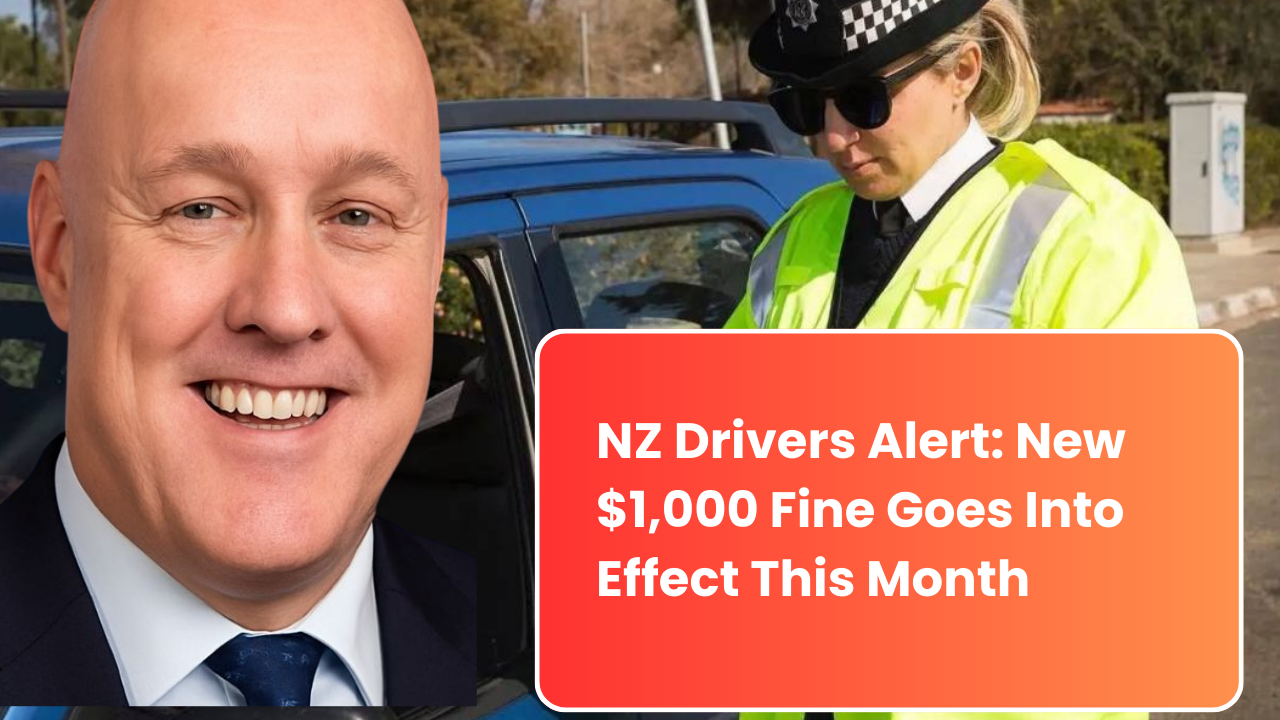
Across New Zealand, drivers are being warned about a new $1,000 fine that has quietly gone into effect this month, catching many motorists off guard. While the rule itself is not brand new, enforcement has changed sharply, and authorities confirm penalties are now being issued faster, more consistently, and with far less discretion than drivers are used to.
For some, the fine arrives without a roadside stop. For others, it comes days later in the mail. Either way, the financial shock is real — and December’s heavier traffic, holiday travel, and unfamiliar routes are increasing the risk.

In West Auckland, delivery driver Mark said he didn’t realise enforcement had shifted. “I thought it was a warning-level issue. The letter showed up and it was nearly a thousand dollars. No warning at all.”
In Dunedin, a retired motorist said the rule change wasn’t clearly communicated. “I’ve driven for decades. I didn’t know this behaviour now attracts a four-figure penalty.”
Here’s what drivers need to know, what triggers the $1,000 fine, who is most at risk, and what to do immediately to avoid it.
What the $1,000 fine actually applies to
The $1,000 fine is not for a single minor mistake. It applies to serious road safety breaches that are now being enforced automatically or at higher thresholds, especially where risk to others is considered high.
Offences most commonly linked to the fine include:
- Dangerous driving behaviours captured by automated systems
- Serious speed breaches in high-risk or restricted zones
- Repeat offences detected within short timeframes
- Certain mobile phone and distraction-related violations
- Lane misuse and restricted-area driving in monitored zones
In many cases, the fine reflects combined penalties, not just a base infringement.

Authorities say drivers often underestimate how quickly smaller breaches stack into a larger penalty.

Why this feels new to drivers
Many drivers believe a brand-new law has been introduced. In reality, the rules existed — enforcement has changed.
Key shifts include:

- Expanded camera coverage
- Automated detection and processing
- Reduced warning discretion
- Faster escalation for repeat or serious breaches
A transport official said, “What’s changed is consistency. The system no longer overlooks behaviour it used to.”
For drivers accustomed to warnings or officer discretion, the transition feels sudden and severe.
The role of automated enforcement
Automation is a major reason fines are increasing.

Automated systems now:
- Detect offences instantly
- Record evidence digitally
- Generate infringement notices automatically
- Apply penalties without roadside interaction
There is no opportunity for explanation or warning at the time.
A road safety analyst said, “Automation removes the human filter. The rules apply the same way every time.”

Why December increases the risk
December is one of the most dangerous months on NZ roads.
Contributing factors include:
- Increased traffic volume
- Holiday travel on unfamiliar roads
- Fatigue and distraction
- Time pressure
- Alcohol-related risks
Authorities intentionally intensify enforcement during this period to reduce serious harm.

A police spokesperson said, “December is when risk spikes. Enforcement follows risk.”
Speed-related triggers behind the $1,000 fine
Speed remains the most common contributor to high-value fines.
Drivers are being caught for:

- Exceeding limits in temporary roadwork zones
- Speeding in areas with vulnerable road users
- Repeated minor speeding within short periods
- High-range speeding offences
Temporary speed limits apply at all times, even when work crews are not present.
Many drivers say they did not realise how strictly these zones are now monitored.
Mobile phone use is a growing factor
Mobile phone enforcement is now one of the fastest-growing sources of heavy fines.
Drivers are being penalised for:
- Holding a phone, even briefly
- Touching a mounted phone
- Interacting with screens while stopped
- Repeated phone-related breaches
Under current enforcement, multiple phone detections can escalate penalties rapidly.
A driving instructor said, “Hands-free means hands off. Anything else is risky now.”
Lane misuse and restricted zones
Another area triggering large fines is lane and zone misuse.
This includes:
- Driving in transit lanes without eligibility
- Entering restricted areas
- Ignoring temporary traffic controls
- Misusing bus or emergency lanes
With expanded camera monitoring, these offences are being detected more often.
Drivers often assume brief misuse will go unnoticed. It doesn’t.
Repeat offences escalate quickly
One of the biggest surprises for drivers is how fast penalties escalate.
Under current enforcement:
- Multiple infringements stack
- Reduced grace periods apply
- Escalation thresholds are lower
A series of small mistakes can result in a four-figure fine within weeks.
A legal adviser said, “It’s not always one big mistake. It’s several small ones adding up.”
Seniors and experienced drivers are not exempt
This is not just a young-driver issue.
Seniors are being fined for:
- Intersection habits that no longer meet standards
- Phone handling assumptions
- Lane confusion in updated road layouts
Senior advocacy groups say enforcement has outpaced education.
A 72-year-old driver said, “I wasn’t reckless. I was unaware.”
Young and restricted drivers face added consequences
For young drivers, a $1,000 fine can trigger more than financial pain.
Additional impacts include:
- Demerit point accumulation
- Licence suspension
- Employment risks
- Insurance complications
Parents say the financial hit often affects entire households.
Shared vehicles create shared problems
Households sharing vehicles face added risk.
Common issues include:
- Notices sent to vehicle owners, not drivers
- Delays in identifying who was driving
- Escalation due to missed response deadlines
Keeping vehicle details current is essential.
Why warnings are no longer common
Drivers often expect a warning for first-time or borderline offences.
That expectation no longer applies because:
- Cameras cannot issue warnings
- Automated systems prioritise consistency
- High-volume enforcement removes discretion
A community law worker said, “The system doesn’t know your intentions — only the breach.”
What happens if you ignore the fine
Ignoring a $1,000 fine can quickly make things worse.
Consequences may include:
- Late payment penalties
- Additional administrative fees
- Debt collection
- Court involvement
The original fine is often the smallest part of the eventual cost.
Can you challenge the fine
Fines can be challenged, but only on limited grounds.
Valid reasons include:
- Incorrect vehicle identification
- Evidence of system error
- Incorrect time or location
Claims based on lack of awareness rarely succeed.
Acting quickly improves the chance of review.
What the Government says
Officials defend the enforcement changes as necessary for safety.
A Government representative said,
“Serious road safety breaches demand serious consequences. Automation ensures consistency and saves lives.”
Authorities point to reductions in high-risk behaviour where enforcement is strongest.
What drivers should do immediately
To avoid a $1,000 fine, drivers are advised to:
- Assume all rules are strictly enforced
- Keep hands completely off phones
- Obey temporary speed limits without exception
- Respect lane restrictions
- Drive defensively, especially in December
Small habit changes make a big difference.
Advice for families and carers
Families should:
- Discuss enforcement changes
- Review shared vehicle responsibilities
- Check mail and digital notices promptly
- Help seniors and young drivers understand updates
Communication prevents escalation.
Why these fines are here to stay
Authorities confirm high-value penalties and automated enforcement are permanent.
Future trends include:
- More cameras
- Smarter detection technology
- Faster processing
- Less discretion
Drivers who adapt now will avoid repeated penalties later.
What this means for everyday driving
Driving in NZ now requires:
- Constant awareness
- Updated habits
- Zero tolerance for “small” breaches
What once felt routine may now be costly.
Key things drivers must remember
- A new $1,000 fine is now being issued this month
- Enforcement, not the law, has changed
- Automation removes warnings
- December increases risk
- Small mistakes can escalate fast
- Awareness is essential
The cost of not adapting is high.

Q&A: New $1,000 fine explained
- Is this a new law?
No, enforcement has changed. - Why are fines higher now?
Automation and escalation. - Are warnings still given?
Rarely. - Does this apply nationwide?
Yes. - Are seniors affected?
Yes. - Are young drivers at risk?
Very. - Do temporary speed limits always apply?
Yes. - Can multiple small fines add up?
Yes. - Can I dispute the fine?
Sometimes. - Is December riskier?
Yes. - Are cameras involved?
Often. - What if I ignore it?
Costs increase. - Is this permanent?
Yes. - How do I avoid it?
Strict compliance. - What’s the best advice?
Assume zero tolerance everywhere.










Leave a Comment